Blog & articles
Can I Get Better With Indoor Golf?
Yes, if you practice with intention. What the data and coaches say about improving your golf game indoors, and how to make every simulator session count.
It is the first question almost everyone asks when they walk into an indoor golf club: can you actually get better hitting into a screen? It is a fair question, and the honest answer is yes, with one condition. Indoor golf improves your game when you treat it as practice with a purpose, not just swings in a dark room.
The short answer: yes, if you practice with intention. Coaches and the data behind modern launch monitors agree on the formula for improvement: more quality reps plus better feedback. Indoor golf delivers both in abundance. What it will not do is fix your game while you mindlessly beat balls, which is just as unproductive indoors as it is on a range. The golfers who improve are the ones who show up with intention.
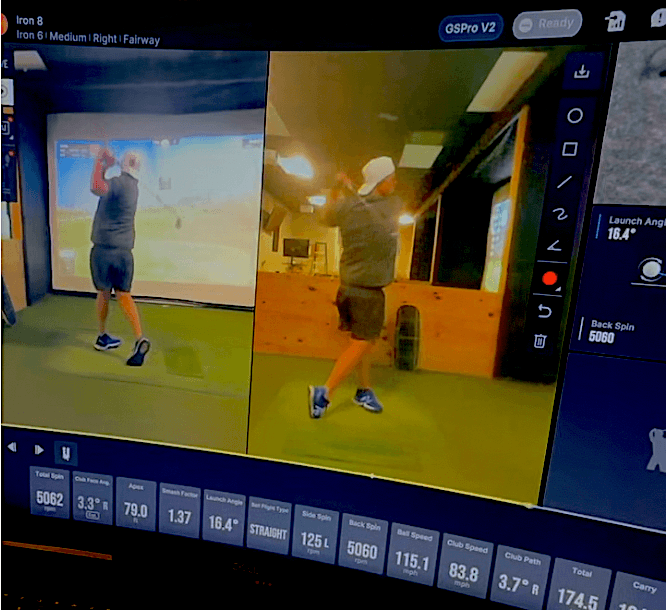
Why a simulator can beat the driving range. On a typical range, you hit a shot, watch it sail into a field, and guess what happened. Indoors, every shot hands you the numbers: club path, face angle, launch, spin, and carry distance. That instant feedback lets you see whether a swing change actually worked, instead of chasing a vague feel. Real-time confirmation like that is one of the fastest ways there is to learn, because you are diagnosing causes, not just admiring effects. At Scramblers, our bays run on Uneekor launch monitors, so the data you react to is real ball-and-club measurement, not a video-game approximation.
Reps, weather, and the 3 a.m. factor. The other half of improvement is volume and consistency, and that is where indoor golf quietly wins. Golf is brutally seasonal. A few months off over winter can erase a whole summer of progress and leave you re-learning fundamentals come spring. Indoors, none of that applies. Rain, heat, darkness, the dead of winter, 3 a.m.: the bay is always open. Even short, focused sessions of 15 to 20 minutes are enough to keep your tempo and muscle memory intact, and you can play a full 18 in about an hour. More good reps, more often, is exactly the kind of compounding that moves a handicap.
What indoor golf is great for:
- Dialing in your true carry distances and gapping every club in the bag
- Grooving a swing change with measurable proof it is working
- Building a repeatable pre-shot routine and consistent tempo
- Shot-shaping and rehearsing real scenarios, like that 160-yard approach or the dogleg fade
- Staying sharp and competitive year-round
The honest part. Indoor golf is not a magic wand, and data alone will not fix a swing you cannot interpret. But a true camera-based bay means you are not guessing. High-speed video on every swing, plus the raw club-and-ball numbers, shows you why a shot did what it did, not just the result. That is a genuine fast track. A good coach can still speed things up by helping you read the data and prioritize what to work on, but the full diagnostic picture is right there in front of you. The one real caveat is that a few things still want grass, like reading greens, awkward sidehill lies, wind, and the feel of a live bunker, so the strongest plan blends bay sessions with the occasional outdoor round.
How to actually get better in a bay:
- Pick a specific target and one swing thought on every shot, with no autopilot
- Watch one or two numbers at a time, not all of them at once
- Randomize clubs and lies instead of hitting the same 7-iron fifty times
- Play scored rounds to put your swing under real pressure
- Track your sessions so you can actually see progress over the weeks
So, can you get better with indoor golf? Yes. Used with intention, indoor golf gives you the two things improvement actually requires, more reps and better feedback, available whenever you want them. That is exactly why Game Improvement is one of the three pillars Scramblers was built on, right alongside access and community. The course is open at 3 a.m., and your next breakthrough does not have to wait for spring.