Blog & articles
Understanding Ball Data: Club Path, Face Angle, and Why Your Ball Curves
Club path, face angle, and face to path in plain English. Understand your launch monitor data and why the ball draws, fades, hooks, or slices.
Step into a Scramblers bay, hit a shot, and the screen lights up with numbers: Club Speed, Ball Speed, Launch Angle, Club Path, Face Angle, Face to Path, Side Spin. For a lot of golfers, that is the exact moment the eyes glaze over. It doesn't have to be that way. Once you understand a handful of these numbers, your Uneekor data stops being a wall of statistics and starts telling a simple story: where your ball started, which way it curved, and why. Here is that story in plain English.
Two numbers explain almost every shot. The left-and-right shape of a shot, the part most golfers fight, comes down to just two of Uneekor's readings: Face Angle and Club Path. Nail those two and the rest of the side-to-side data (Side Angle, Side Spin, Spin Axis, Ball Flight Type) is simply the screen describing what they created. Remember it as one sentence: the face starts the ball, and the gap between the face and the path bends it.
Face Angle is where your ball starts. Face Angle is the direction the clubface points at the instant it meets the ball, measured against your target line. It is the single biggest factor in your starting direction. Launch-monitor data shows the face controls roughly 75 to 85 percent of where the ball sets off, and the longer the club, the more the face dominates. For a right-handed golfer, a face pointing right of target (open) starts the ball right, and a face pointing left (closed) starts it left. On the Uneekor screen, the ball's actual starting direction appears as Side Angle. If your shots keep starting offline, the face, not your swing, is almost always the reason.
Club Path is the direction the club head is traveling. Picture the clubhead moving through the ball. Is it swinging out-to-in (across your body, toward the left for a righty) or in-to-out (out to the right)? That is Club Path. Uneekor reports it as a number: negative means out-to-in (left), and positive means in-to-out (right). On its own, path does not start the ball and does not by itself decide the curve. Its real job shows up in the next number.
Face to Path is the gap that bends the ball. This is the reading that ties everything together, and it is the one most golfers have never had measured before. Face to Path is simply the difference between your Face Angle and your Club Path, or how open or closed the face is relative to the direction the club is moving. That gap tilts the ball's spin (Uneekor shows it as Side Spin and Spin Axis) and curves the ball through the air:
- Face closed to the path (pointing left of where the club is moving) makes the ball curve right-to-left. That is a draw, or a hook if the gap is big.
- Face open to the path (pointing right of the club's direction) makes the ball curve left-to-right. That is a fade, or a slice if the gap is big.
- Face matching the path (gap near zero) produces no curve at all. The ball flies dead straight along wherever it started.
The size of the gap controls how much the ball curves. A degree or two gives you a smooth, playable draw or fade. Push past about five degrees and that gentle shape turns into a hook or a slice.
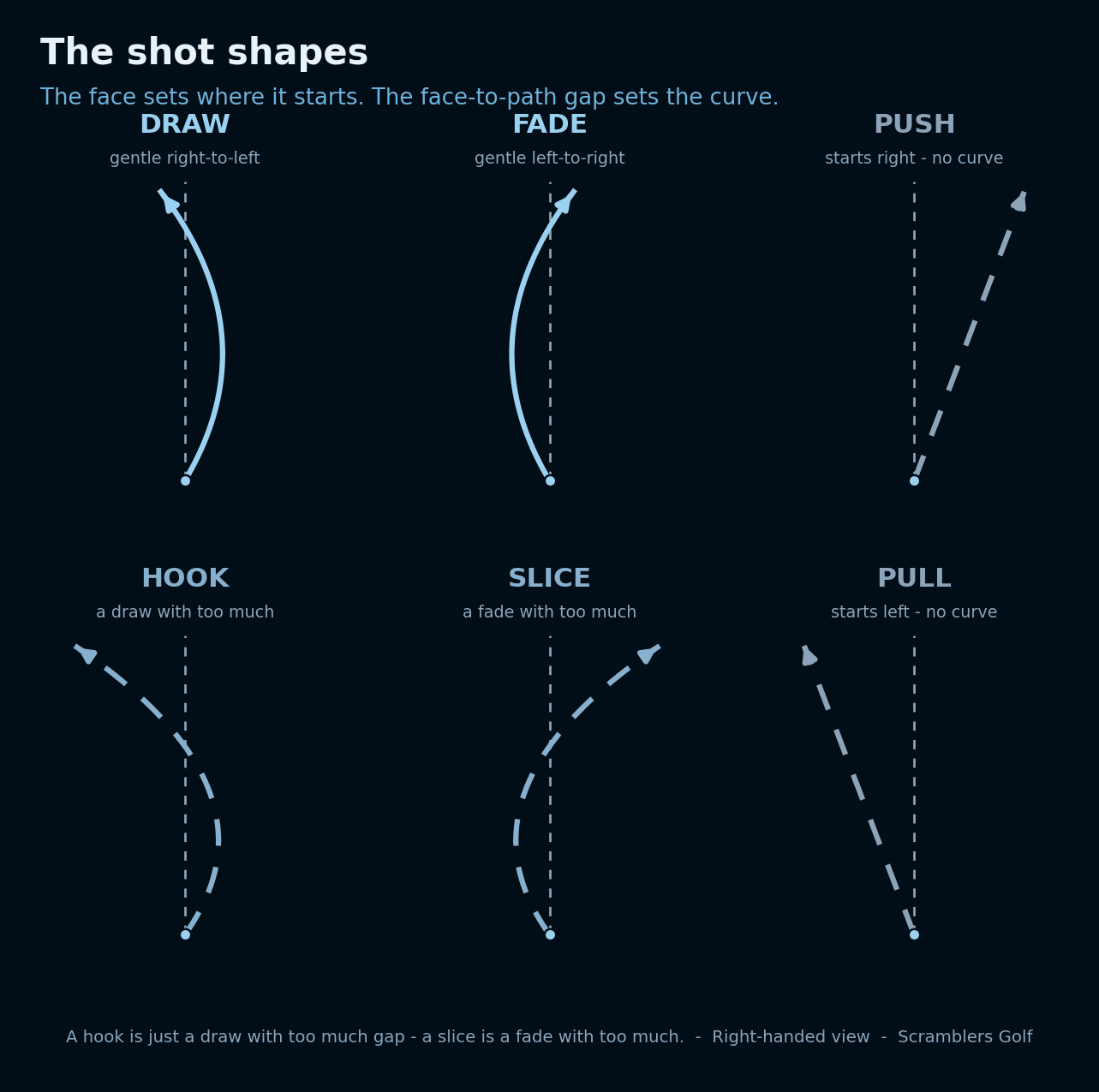
Now the shot shapes make sense. Every shot you have ever heard named is just a combination of those two ideas: where the face pointed (the start) and how big the face-to-path gap was (the curve). For a right-handed golfer:
- Straight: face square to target, path matching the face. Rare, and honestly overrated, since even pros mostly play a curve.
- Draw: a gentle right-to-left curve that settles on target. Face slightly closed to the path.
- Hook: a draw with too much, a hard right-to-left dive. Face well closed to the path.
- Fade: a gentle, controllable left-to-right curve. Face slightly open to the path.
- Slice: a fade that got away, a big left-to-right peel. Face well open to the path.
- Push: starts right of target and stays straight. Face and path agree with each other, but both are aimed right.
- Pull: starts left and stays straight. Same idea: face and path agree, but both are aimed left.
Notice the pattern: a draw and a hook are the same shot in different amounts, and so are a fade and a slice. That is the part most golfers never get told. You do not cure a slice by learning a brand-new swing; you cure it by shrinking the face-to-path gap. And a push or a pull is not a curve problem at all. It is an aim problem, because the face and path were pointed the same way, just not at the target. (Left-handed? Everything above simply mirrors, so swap left and right.)
How to use this on your next visit. Do not try to read all twenty-plus numbers at once. Read the story in order:
- Look at Side Angle first. Where did the ball start? That points back to your Face Angle.
- Then look at how it curved and check Face to Path. That is your draw or fade, and how much of it.
- Change one thing, hit again, and watch those two numbers move. Because the data is measured, not guessed, you get an honest answer on every swing.
That is the quiet advantage of practicing on a real launch monitor: the ball-flight laws stop being theory you read about and become numbers you can actually move. Understanding your data is where game improvement starts, and it is exactly what our bays are built around. Come read your own numbers. The course is open at 3 a.m.